The recipe is rather common these days. An artistic director — here Jan Vandenhouwe of Opera Ballet Vlaanderen, a wish list that includes Prokofiev`s Romeo and Juliet, an orchestra — conducted by a leading ballet specialist, here Gavin Sutherland, a corps de ballet to set, or keep, in motion, and a ballet star called upon to activate, or re-activate, the movement machine — here Marcos Morau, founder of La Veronal and artist in residence at Nederlands Dans Theater and Zürich Ballet, as well as already a creator for the Staatsballett Berlin. Add the masters of their respective liminal fields — set design, dramaturgy, lighting and costumes — here respectively Max Glaenzel, Roberto Fratini Serafide together with Koen Bollen, Silvia Bernat Jansà and Silvia Delagneau, and there it is: the monumental production of Romeo + Julia.
Like all algorithm, however, the glitch lies in wait; from the “psycho-architectural“ — where the balcony of the otherwise impressive Concertgebouw Brugge complex proves not to be vertigo-proof, (and I am indeed speaking from experience here!), to the “symbolic-partitural“ — where orchestra and corps de ballet prove not to be monumentality-proof. After a spectacular entrance procession — somewhere between a haute couture runway and the painted background of some Flemish primitive (visible on one of the many museum walls of Bruges or Flanders in full), Prokofiev`s arrival from the orchestra pit produces a fracture that seems not structural, but accidental. Bodies and notes appear to enter — not of their own will, into two dystonic dimensions. Performers, for they are neither dancers nor actors, and instrumentalists, unseen and unheard from one another, end up not telling the same story.
The one, extraordinary exception — which perhaps confirms the accidental nature of an evening not quite in tune?, a very brief organic moment — during one of the many “dances of the knights“, when what-could-have-been gives itself to be glimpsed beyond what-actually-was, at the algorithmic heart of the perfect performative formula. Which, on the other hand, suggests that perhaps — “a-syntonic“ incident aside, each ingredient-element of the recipe-formula simply does not lodge within the other. And it is perhaps no coincidence that the production finds it almost called for, to rush to the aid of the readers of this “un-score“ — much as the front-of-house staff rushed to assist me with my vertigo attack! — with a glossary of Morau`s applied symbolism. And yet, as we know well by now, a fluid performative experience, even at the heart of the most contemporary hermeneutics, needs no translation.
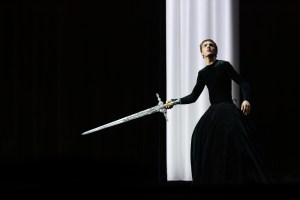
The concept of the star-choreographer remains, however, deeply compelling: two children at play and a guardian angel of the higher ranks — bearing, in fact, a sword, albeit Hamletic, to defend them from a chaos fair that distils the most important tragic element of the Shakespearean original: the ferocious hatred between the two families, which here becomes far more than a series of street-corner bagatelles in Verona; it turns global, metaphorical, almost Heiner-Müllerian. A “Romeo-Machine“ lamenting a world stripped of all mercy, which humanity is processionally bequeathing to its young; a parade of maniacal and semi-demoniacal figures. Somewhat like the hidden corners of the Flemish primitives. The light, however, is too sparse — even to render that chiaroscuro the production is after, much as in the surrounding museum compounds, almost as if to conceal those very monsters that, in truth, inhabit everywhere.
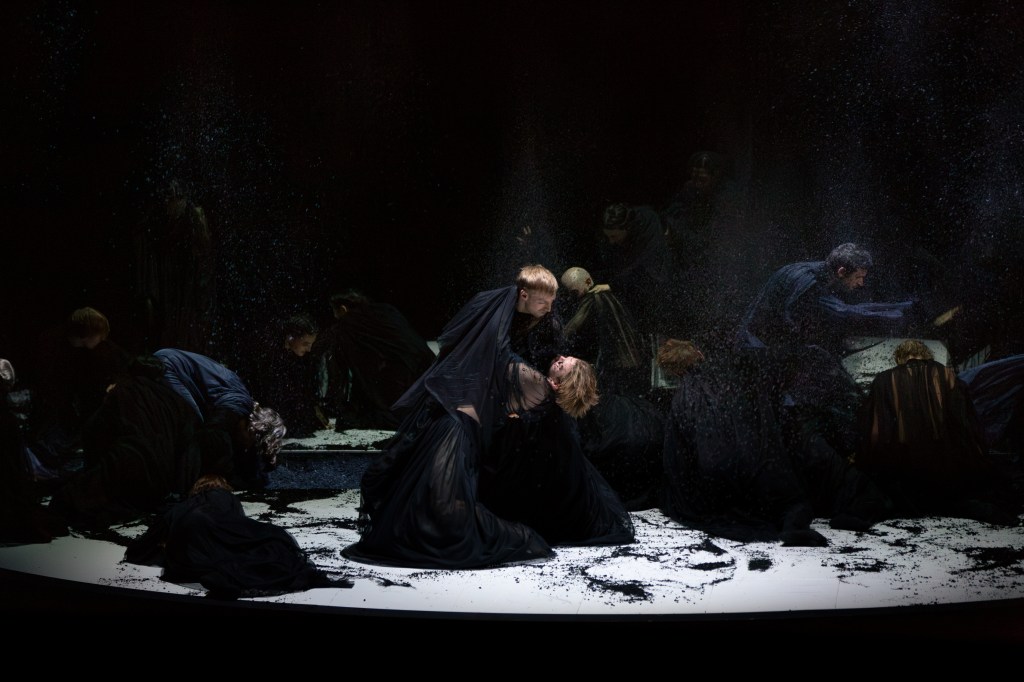
The glossary becomes indispensable here: circle — or the circus, as in the arena of a bestial paralysis; horse — or the totemic herald of a bellicose-belligerent anthropology; fire — as uncontrollable as the love that is absent, replaced by couplings, devoid of all sensuality; candles, anticipating the mourning to come; tournament, or the giostra — simulating war games in the final mud of the two young souls` funerals, returned to the earth. As needed, too, are the uncomfortable, almost vexing contortions Morau imposes on his performers, each one for each, without assigned parts — that gesture of the head tilted to the left, the laughter following the cortège`s progress, from jovial to mad. And the costumes, which fill these distortions well, and define darkness as the new black of a “tourist-cultural“, but above all, fashion — aesthetics. Up to a point that the eye seems at a given moment to see tall white collars even where there are none.
So yes, the children are watching us, I bambini ci guardano — as per De Sica`s citation present in the programme, and we are watching the children. Defended into madness.
Or, as we might perhaps close, with a Shakespearean cast:
All the world is chaos
And all the boys and girls are merely — hopeless, spectators
© Danny Willem
 Shakespearean Tales