Farewell, aerial Genius…

Nothing less than a precious cameo, becoming `a natural born Shakespearian actor` at the height of his career. `The Tempest`, last on stage 2019, now in streaming on the Elfo-Puccini website, is a gracious window on a wise, poetic soul, well-informed about himself, and his life as a performer. A one-man show tailor-made for Ferdinando Bruni — founder member of storied Teatro dell’Elfo, from the co-authorship pen of Francesco Frongia. Pouring out of an intimate recounting, this short, yet intense version of `the last tale`, leans on specific predilections as a theatrical concerto, in and about the original plot, to act as an aesthetic statement gem, a gift from an actor to his audience as a tribute to life.

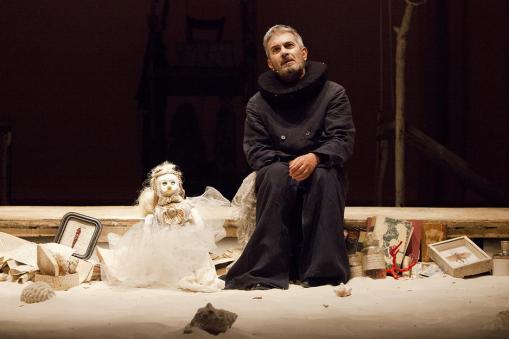
In little more than an hour, alone on stage, with just a couple of extra `island servants`, all the characters parade as a fictional court by the hands of Prospero the wizard-master-father-player. Shipwreck discloses the whimsical `pirate of destinies`, — in a torn stovepipe hat, brown Elizabethan collar, dark frayed coat-gown, diverting his and his daughter’s life on a white sand island — memories of old shores popping out from a distant past, smooth branches scaffolding light drapes. White sand canvases, where animated figures come to life on stage through different voices, accents, and a perfect `soundtrack` — as if inherent part of the dramaturgical `arrangement`.

Books surround a wooden stage-on-the-stage — those same books whose main sin was to have diverted attention from power, thus easing a brother takeover. On this set-in-the-set, Miranda is cuddled as a doll, before turning into an oneiric figure, Japanese Bunraku-like marionette, made up assembling recovered materials. Similar semblance is reserved for Ferdinando, while engaged into the capricious ordeal, before the final blessings. Same goes for the skull masked Alonso-Gonzago and Antonio-Sebastiano pairs, in a carousel of intrigues directed on stage as in a Días de los muertos setting — an anticipation of the final forgiveness which is here son of the fear of death.

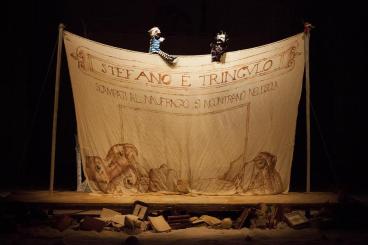
Glove puppets are instead reserved both for Ariel — or the `aerial Genius`, who is the guardian of life itself in Prospero’s magic, here conceived as an all white transparent fabric plot and a tiny head in a Pulcinella-like hat, and his opposite, the deformed, half-human, devilish Caliban, an alluring Mamuthones mask, changing dimensions depending on his presence in each line. Therefore, big in the encounter with Stefàno and Trincùlo, whose hilarious Salentinian accent brings about some show-into-the-show made of a liquor-induced obscene score. Gracious, on the other hand, is the heart-rending closure, whilst the old man who has let his `spirit` and his magic go, thanks his public for understanding.

`Now my charms are all o’erthrown and what strength I have mine own`
lucapiva_054

lucapiva_117

© Luca Piva

A vintage `dream`

In the darkness, some light from the cabin of a road vehicle is a sight alert. The driver bickers with the ignition mechanism. Once. Twice. Thrice. Then `boom!` a burst from the tailpipe. The man gives in, yawns, falls asleep. On the notes of Rossini’s La Cenerentola — `Un soave non so che, In quegli occhi scintillò. Io vorrei saper perché, Il mio cor mi palpitò`, placidly four characters come in from the parterre, and once gained on it, the stage lightens of a `night light`.

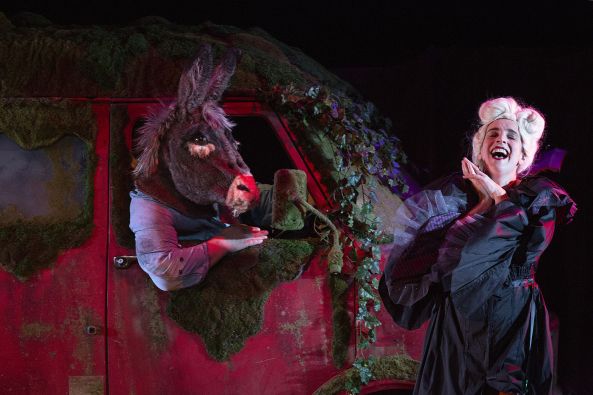
Imagination goes to a nineteenth-century circus: a cabaret cigarettes seller in a top hat and frayed tails, a similarly disguised gentleman, a shy girl, and a very blonde lady with a birds cage and a hat box. They all carry suitcases, and camp out the main prop of this super minimal stage setting: a Volkswagen van dated 1960s, bound to have been sky blue in its former greatness, it stands now just a rusted flat tyres carrier, home for lichens and moss.

This is the entrance into Dan Jemmett’s `Dream` whose adaptation, Je suis invisible!, — debuted in world premiere at the Théâtre de Carouge in Geneva in 2019, and here recounted from a video, hits a set of about ten Shakespearean `passages` in the course of a period of about twenty years. Quite a peculiar `frequentation`, as almost exclusively occurred in French, at the hands of a British director. Intentionally exiled, as some distance needed to be put, in order to explore the makings of that close connection in a more `continental` manner.
The above is not the only specificity of `Jemmett’s Shakespeare`, though.

There’s a narrative, — which is as much a theatrical, as an existential narration, associated with it. Jemmett’s `Shakespearean aesthetics` is founded on a biographical dig up and its alchemical transformation into a performative product — as already became clear almost in a `repertoire` sort of measure, in his 2002 Shakes. Childhood or adolescence memories, vintage picture postcards, vinyl records, `kinematograph souvenirs`, old tunes, consistently feed a theatrical practice which is a `tale` to the self happening before the mise-en-scène.

In his director’s notes for this specific project, an autobiographical short-circuit weaves `I am invisible`, the Act 2, Scene 2 line Oberon whispers to the audience while he wants to escape the lovers’ sight, and the recollection of an old American movie dated 1940, his father used to enjoy, My Little Chickadee, starring Mae Waest and W.C. Fields. That is how the iconic Hollywood couple, immortalised in the long opening sequence on a train running on some Far West rails, gradually turned into the royal faerie couple.

A `flipped` narrational theatre, almost a `journaling` practice. `Choral`, though. Even if there are never a large number of actors on stage. Just five here — as many as the `artisans in the forest-rehearsal room`. Thus, in perfect adherence to the demands of the original plot, given that the superabundance of pairs agrees with a reusing of performers. That is how the dozing driver awakened all of a sudden, abruptly turns into the Duke of Athens. The latter occurring as soon as he enters the ground of the `dream`, that is when he gets off his vehicle…

From this sort of time machine, the players get in and off, as they get in and off their parts. Into what seems to be a bit of a rundown `campìng` (please do emphasise the French accent), or the backstage of a vintage circus, the triple plot line goes in and out. The (as usual) impeccable `soundtrack` ranges from The Ink Spots, We Three, introducing the fairy world — one only rather melancholic pixie here, to Jack La Forge, Cleopatra Kick, underlining the sleight of hand Mae-Titania — soon to be donkeys’ `tamer`, performs on the contended changeling.

And then Roy Orbison, Beautiful Dreamer, whilst the blonde queen falls asleep under a constellation of small lights, Winifred Atwell, The black and white rag, for the tap dance of the most docile Puck ever, Blondie, The Tide is High, while the young lovers sleep and the juice of the `flower of love` makes its magic, Fred Astaire, Cheek to Cheek, when the lady-queen reconciles with her gentleman-king, and Sam Cooke, Cupid, when the driver gets back into the cabin and goes back to sleep. This time stepping out of the `dream`’s ground filling Bottom’s shoes, in the wake of a different performance, of another awakening…

Je vous prie, pas d’épilogue…
Notre pièce n’a pas besoin d’excuses
Mais ne vous excusez jamais
Car quand tous les acteurs sont morts
Nul besoin d’excuse,
Ni de blâmer qui que ce soit

csm_2_Je_suis_invisible__31644e3e36

Seen on video. A special thanks goes to Jane Carton who sent out Bruno Ochoa footage.