Shakespeare theatre is living matter in the hands of time, and whether that is true, Thomas Ostermeier Richard III is an impeccable measure of the present time. Ultracontemporary adaptation of a Shakespearean `décor`, set up `within` the Schaubüne Berlin — or, to put it as Time out does, `the coolest theatre in the world`, the same impressive setting was recreated at the Opéra Grand Avignon in 2015.
It is one perfect circle of dust, whose design terminates in a backcloth capturing some sort of neglected industrial estate into a double tiered iron and cement structure. Underneath a note of urban minimalism, details of a discrete splendour, though, are hidden. A Persian carpet hangs as an arras-door, and golden confetti lay on the soon to be a bloody ground, — shining in the mastery of light.
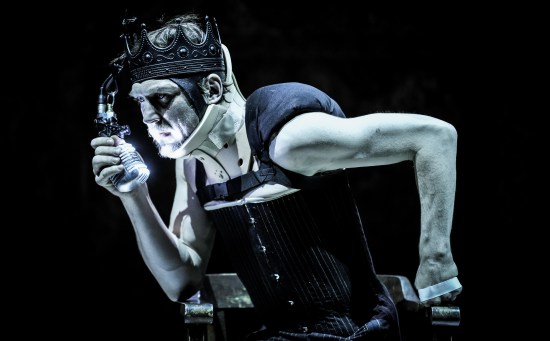
Scattered around in the almost operatic overture by the actors coming on from the parterre, electronic music, entrusted to one drummer on stage, introduces the court. Integrated in an insolently glamorous manner, this Gloucester does not whisper his `discontent` in the shadow. He is not disgusting, and his disfigurements are actually beautiful.
Dashing, in black and white, a leather cap, a plaster on one hand, braces on his teeth, one big clownish foot, a silver band, he stands out immediately as iconic when he gets to an old fashion microphone swinging in the air from a malformed cable, perhaps a never cut umbilical cord. A diseased dynasty it will be of Richmond’s destiny to annihilate.
This Gloucester is seducing. This is how the director wanted him, — found him, in the unbelievable Lars Eldinger, to get into an intimate relationship with the audience, laughing at his jokes, even the most indecent ones. Video emphasises his smiley face, a childish misty-eyed smile, whose tears tell the story of a never completely born body.
Impossible not to love him. Especially when Margaret, his mother, — a role entrusted to a man in a familiar tabloid hairdo, curses him. It’s an `erotica of power` at stake here, which has in beauty its metacritic keystone. Lady Anne’s beauty, mourning on his father’s coffin, and he prompting it as a confession which turns her pain into sensual euphoria while he poses naked, a sword against his chest.
Not just the small scene details disclose that splendour underneath minimalism, but words too. Emphasized in the most intense soliloquies of the Canon, — in English, associated to techno-rock fragments, and in video underlined further through fluid images, and aerial shots: a sky with vultures, the land of England, soon to be reunited in white and red.
Not before having navigated the dense plot line of Richard’s mind, as in the sinuous rivers cutting through that land. One thick net of cheerful manipulations: Buckingham, cousins — reduced to ventriloquist dummies, Lord mayor and citizens of London. The umbilical microphone as the direct connection to the audience deciding for the key question of the play: Do we really want Richmond to win?
No. Not here. Not even when all the victims stand one behind the other into the dream before the battle, when King Richard’s face turns white — Elizabethan in his becoming reign, throne. There he sleeps, and in the half-sleep whispers his final call. No horse comes, though, and the last hand-to-hand is fought solo against his invisible nemesis. Until he rests, hanged by the foot, cutting the cord.
`The Devil does not wear Prada`.
Seen in streaming on April 3, 2020
 Shakespearean Tales