
The surreal “Glyndebourne experience“ commences at Lewes station, East Sussex. Ladies in evening gowns and gentlemen in black tie arrive from London Victoria on the 14:47 train, laden with picnic provisions. Composed and elegant, they board the fleet of white minibuses. The last shuttle to reach the opera house departs at 3pm, though the performance does not begin until 5. The unhurried but strategic early arrival is essential: one must identify the perfect spot in the seemingly endless lawn in front of the Christie family mansion.
The cultural shock on arrival is considerable. You enter a dimension that is perhaps even more quintessentially British than Ascot: sheep grazing in the distance beyond the mere, contemporary sculptures beyond the rose garden, and an audience inhabiting this private location in the most aristocratically public manner. The effect is idyllic and romantic. The history, after all, is a love story — that of John Christie and Audrey Mildmay, he wealthy, she a soprano, and as a gift: a concert hall. Since 1934, a meeting point for opera lovers.
The occasion that brings us here is the world premiere of Hamlet — presented at the festival in eight performances and broadcast to British cinemas and online on 6 July. A new opera in two acts by Australian composer Brett Dean, libretto by Canadian Matthew Jocelyn, directed by Neil Armfield, received with enthusiasm by the British press.
The Shakespearean adaptation chooses to enter the plot at the festive banquet for the hated wedding that followed the funeral, with the full cast present — all in evening dress and black tie, producing that mirroring effect which is perhaps essential to draw us into a familiarity that the atonal music will then carefully dismantle. Which happens almost immediately after the prelude, dominated by a repeated “…or not to be“.
The absence of melody, in the hands of Russian conductor Vladimir Jurowski, is orchestrated in an almost Hitchcockian manner — with the aid of unconventional instruments (entrusted to the London Philharmonic Orchestra) conceived for the specific acoustics of the hall, and part of the chorus positioned among the orchestra players. The sense of danger rises in volume until the moment of acute pain — the moment Ophelia`s heart breaks. And you feel it. “I loved you not.“
An extraordinary interpreter: soprano Barbara Hannigan moves through the performance like an independent installation, almost a contemporary dancer in the second act — perhaps through the composer`s artistic contamination with painter Heather Betts.
The high white walls chosen by Armfield resonate as a by-now canonical quotation of Sir Branagh`s Austro-Hungarian `Hamlet.` The Hamlet performed by tenor Allan Clayton, however, wears no uniform — he emerges from the court in a pop, almost punk manner, more at home in 1980s Brighton than in any Elsinore. And he is certainly comfortable when the palace literally opens up for the play-within-the-play, staged in an improvised backstage somewhere on Broadway.
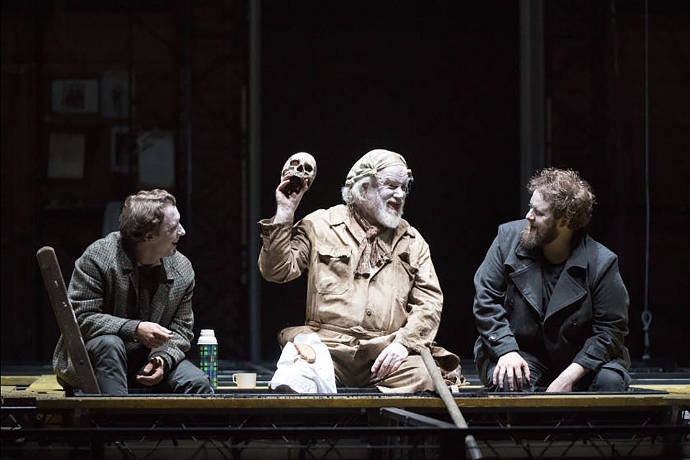
Irresistibly comic — from a musical standpoint — Rosencrantz and Guildenstern, almost operetta. Iconic and unforgettable: bass John Tomlinson, in all three of his roles. As the ghost, in a pre-oedipal embrace that subtly alters the plot as we know it — accounting here for the First Quarto. As the player King, surrounded by a troupe of tenor-actors and in the cameo presence of an accordionist (James Crabb). And as the gravedigger — in the theatrically highest moment, when the stage opens completely and the earth gives back Yorick`s skull. “The readiness is all…“
 Shakespearean Tales