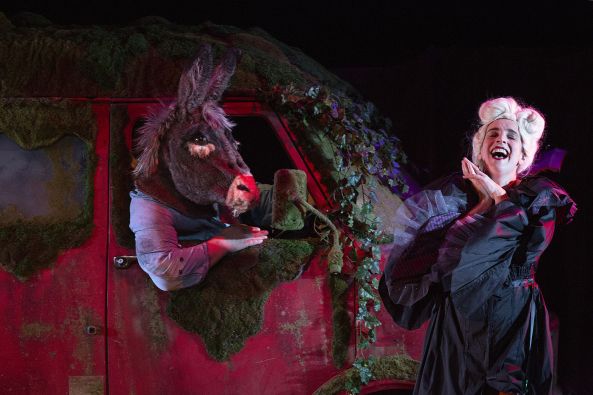
In the darkness, some light from the cabin of a road vehicle is a sight alert. The driver bickers with the ignition mechanism. Once. Twice. Thrice. Then `boom!` a burst from the tailpipe. The man gives in, yawns, falls asleep. On the notes of Rossini’s La Cenerentola — `Un soave non so che, In quegli occhi scintillò. Io vorrei saper perché, Il mio cor mi palpitò`, placidly four characters come in from the parterre, and once gained on it, the stage lightens of a `night light`.
Imagination goes to a nineteenth-century circus: a cabaret cigarettes seller in a top hat and frayed tails, a similarly disguised gentleman, a shy girl, and a very blonde lady with a birds cage and a hat box. They all carry suitcases, and camp out the main prop of this super minimal stage setting: a Volkswagen van dated 1960s, bound to have been sky blue in its former greatness, it stands now just a rusted flat tyres carrier, home for lichens and moss.
This is the entrance into Dan Jemmett’s `Dream` whose adaptation, Je suis invisible!, — debuted in world premiere at the Théâtre de Carouge in Geneva in 2019, and here recounted from a video, hits a set of about ten Shakespearean `passages` in the course of a period of about twenty years. Quite a peculiar `frequentation`, as almost exclusively occurred in French, at the hands of a British director. Intentionally exiled, as some distance needed to be put, in order to explore the makings of that close connection in a more `continental` manner.
The above is not the only specificity of `Jemmett’s Shakespeare`, though.
There’s a narrative, — which is as much a theatrical, as an existential narration, associated with it. Jemmett’s `Shakespearean aesthetics` is founded on a biographical dig up and its alchemical transformation into a performative product — as already became clear almost in a `repertoire` sort of measure, in his 2002 Shakes. Childhood or adolescence memories, vintage picture postcards, vinyl records, `kinematograph souvenirs`, old tunes, consistently feed a theatrical practice which is a `tale` to the self happening before the mise-en-scène.
In his director’s notes for this specific project, an autobiographical short-circuit weaves `I am invisible`, the Act 2, Scene 2 line Oberon whispers to the audience while he wants to escape the lovers’ sight, and the recollection of an old American movie dated 1940, his father used to enjoy, My Little Chickadee, starring Mae Waest and W.C. Fields. That is how the iconic Hollywood couple, immortalised in the long opening sequence on a train running on some Far West rails, gradually turned into the royal faerie couple.
A `flipped` narrational theatre, almost a `journaling` practice. `Choral`, though. Even if there are never a large number of actors on stage. Just five here — as many as the `artisans in the forest-rehearsal room`. Thus, in perfect adherence to the demands of the original plot, given that the superabundance of pairs agrees with a reusing of performers. That is how the dozing driver awakened all of a sudden, abruptly turns into the Duke of Athens. The latter occurring as soon as he enters the ground of the `dream`, that is when he gets off his vehicle…
From this sort of time machine, the players get in and off, as they get in and off their parts. Into what seems to be a bit of a rundown `campìng` (please do emphasise the French accent), or the backstage of a vintage circus, the triple plot line goes in and out. The (as usual) impeccable `soundtrack` ranges from The Ink Spots, We Three, introducing the fairy world — one only rather melancholic pixie here, to Jack La Forge, Cleopatra Kick, underlining the sleight of hand Mae-Titania — soon to be donkeys’ `tamer`, performs on the contended changeling.
And then Roy Orbison, Beautiful Dreamer, whilst the blonde queen falls asleep under a constellation of small lights, Winifred Atwell, The black and white rag, for the tap dance of the most docile Puck ever, Blondie, The Tide is High, while the young lovers sleep and the juice of the `flower of love` makes its magic, Fred Astaire, Cheek to Cheek, when the lady-queen reconciles with her gentleman-king, and Sam Cooke, Cupid, when the driver gets back into the cabin and goes back to sleep. This time stepping out of the `dream`’s ground filling Bottom’s shoes, in the wake of a different performance, of another awakening…
Je vous prie, pas d’épilogue…
Notre pièce n’a pas besoin d’excuses
Mais ne vous excusez jamais
Car quand tous les acteurs sont morts
Nul besoin d’excuse,
Ni de blâmer qui que ce soit
Seen on video. A special thanks goes to Jane Carton who sent out Bruno Ochoa footage.
 Shakespearean Tales