Midsummer, upside down


The forest, in this dream, is the theatre. Theatre room and musik-theater. An ‘’upside-down’’ – or better, ‘’a front-and-back,’’ where Shakespeare is winked at and, courteously, left in the dust, jaw on the floor. 
At the helm, for the signalling, is Tom Goossens — the “beautiful” wunderkind of the “beautiful company”, — Deschonecompanie.

Since 2017, the Ghent-based Flemish company has come to define their authoritative niche in what seems to be some sort of “un-serious” opera. A little more than serious, and less than “un-thought” for, is the in-quest into Midzommernachtsdroom where the chisel operates on a twofold desk.

Arrangement wise, — opting for the way more minimal Benjamin Haemhouts’ over Felix Mendelssohn’s, placing the ensemble of 7 musicians of Casco Phil, physically in the middle of the artisans’ game as if imprisoned faeries, happy to be the tricked ones for once, instead of the tricksters.

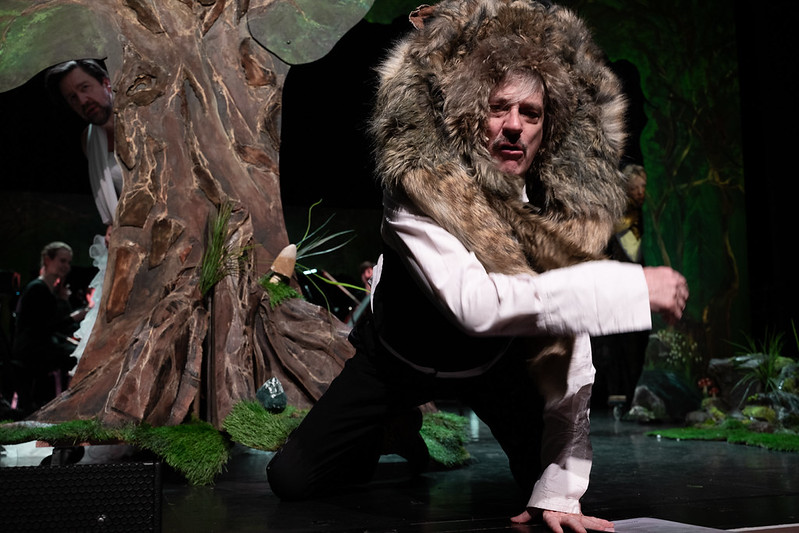
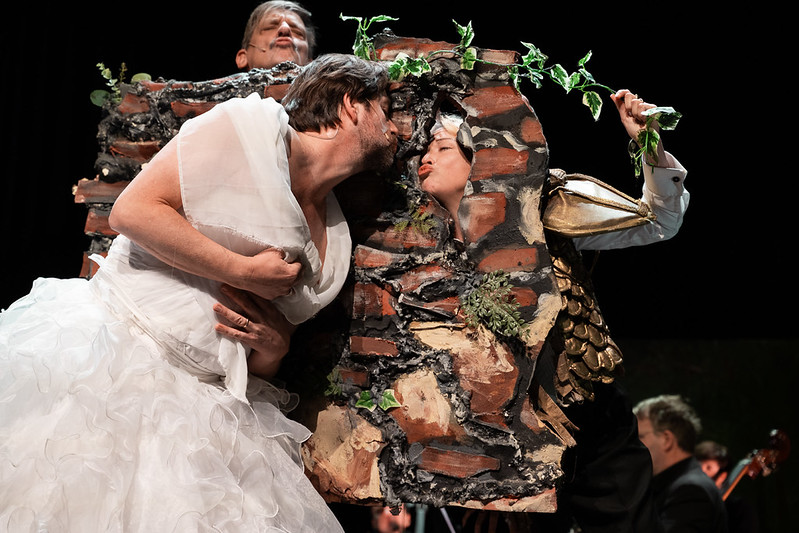
Folio wise, — keeping the magic potion, the artisans, the fog, the “sleep-per-chance-to-dream”, yet rigorously out of donkey head, and the The Most Lamentable Comedy and Most Cruel Death of Pyramus and Thisbe, rigorously inclusive of lion head, in a rhyming libretto.

The actors are the artisans, and they keep their off stage names, in addition to their marital status: more seasoned than their un-seasoned director, the two real-life couples, Koen De Graeve and Arian Van Vliet and Peter Van den Begin and Tine Reymer, lead the theatrical dimension of this Musiktheater Transparant production.

And they take it there where stage presence, voice, improvisation and musical finesse live their own beautiful life; it takes a while to get there, — as if in a rehearsal in the backstage of a forest, but when they finally do act as a wall, —de muur!, a moon-head, a Pyramus and a Thisbe en travestie, they deliver what promised.

Then, and only then, we, the audience, are allowed to see the forest. And it ain’t just any forest…

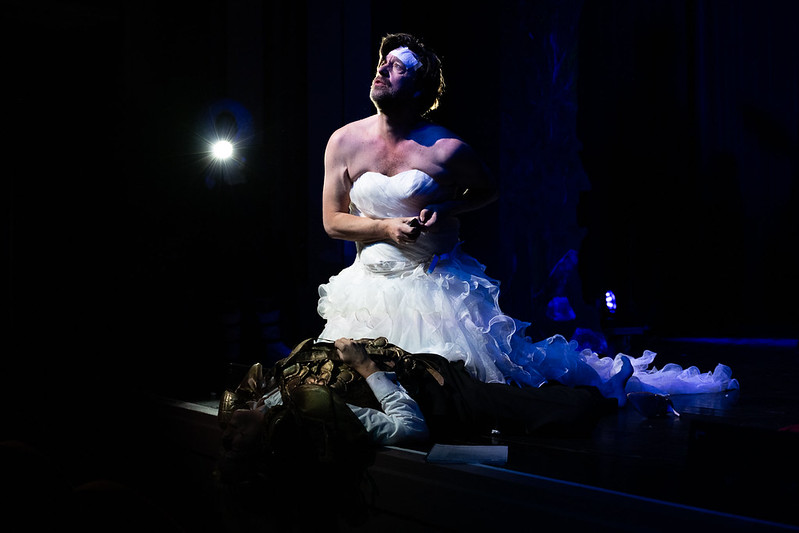
Photo ® Wout Vloeberghs
Fast, yet `unstumble`

Prague is a mysterious creature. Trams run fast, yet silent. Number 22 flies silently to Malá Strana, where the roofs turn silver under a nothing but constant moon. Cinnamon shops, and floating couples, manifest from ancient literary memories, not far from here.

The lovers soon to be seen on stage are the eternal (of all) floaters, yet this time they come to the audience from a place of playfulness, and childish punk. Far from Schultz, or Chagall, courtesy of that expats` beating heart which is the Prague Shakespeare Company.

Founded in 2008 by Guy Roberts — can you recognise him?, PSC believes in the universality of Shakespeare`s stories, and their philosophical resonance beyond time and space. `Shakespeare`s words constantly remind us of our own humanity and through his texts we can better understand our own modern experiences, anxieties, and sensibilities`.

An `educational` genetic code which comes to the professionals of the performative arts, and not — that white orchid which is `Shakespeare in ESL`, for instance, via what is known as Shakespeare Intensive on a seasonal basis.

Meant to attract theatre goers with a passion for English, the intention manifests itself loud and clear in the Divadlo Na Prádle foyer, where conversations and gatherings carry multiple sounds, and sight skims the bills of previous productions on the black walls of a cabaret like venue.

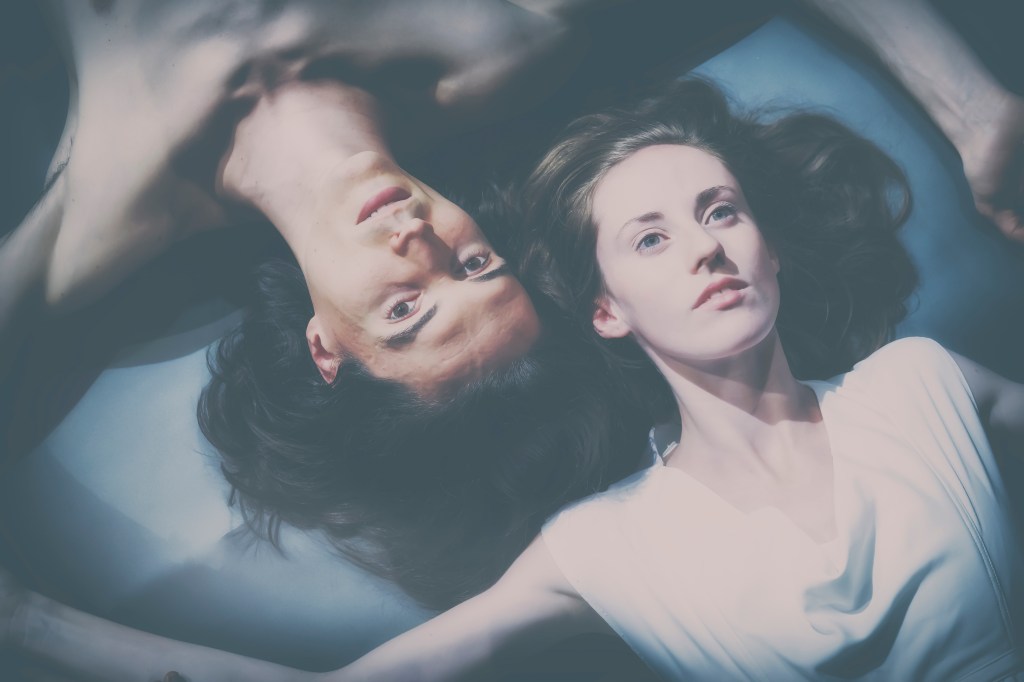
This Romeo and Juliet is directed by the founder of the company together with eclectic Cathy Meils, and stars only five actors for a short version of a little longer than an hour. Cuts favour epitome, but narration flows, sustained by all the actors chorally, yet individually.

Playing the role of `the lover of love`, Jared Doreck also reads the idiomatic line assigned to Abraham, Do you bite your thumb at us, sir? While presenting `the perfect lover` is Sinead Phelps who is also performing as Benvolio, in and out by just wearing a white, virginal apron.

Flirtatious — through and beyond the script, their complicity as actors comprehend the audience, designing an entertaining, almost belletrist, `travesty` of their teenaged characters intimacy. Agents of this dramatic, yet far from dramatical, translation into the now, are a crew of `in-and-outers`.

Nurse and Friar and Prince plus Sampson and Escalus, Vanessa Gendron`s energy pairs up with Elissa Levitt`s Tybalt and Paris and Lady Capulet plus Peter, and Jeff Smith`s Mercutio and Lord Capulet plus Gregory and Apothecary.

A festival of talents whose mission of taking through the canon is accomplished. As fast — yet not without extent, as possible.