The ‘stage keeper’ asks the audience if they are ready. ‘Yes?’ ‘Good. Let’s start.’
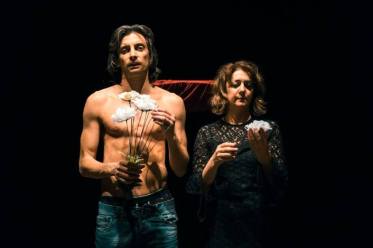
Out of the dark a small set of red curtains gives frame to a crucified-like young man in a white monastic shirt.
‘I do suffer, though I dream
Because of this, I do live.
In the act of dreaming,
I do dive into ‘what I have inside’
That I see, even if it does not really live;
That I loose, if the day after, it turns into real.
Also, I do search for ‘who I am’,
‘who I fake to be’, ‘where I hide’,
In the act of dreaming, I do soothe the pain,
It is the only real sensation.
Life, in the end, is what, — in it, we do imagine:’
The ‘little scene in the scene’ moves towards the centre of the stage as the monologue proceeds, while an accordion, or a pianola, leads the pregnant words introducing Amleto Take Away — whose meaning does not echo ‘a Shakespearean meal to have at home’, but rather the question: ‘What do you want Hamlet?’ in the Bari parlance: Amleto-te-ce-uè?
Nothing more than what we feel, we have,
And this is where the reality of our living
Lies upon, not on what we see.
‘I do suffer, dream, feel, and I am alive, different each day.
This, is what is worth to be or to have,
so that we can be, and have, what we ‘imperfectly’ are.
Ah! If this too, too sullied flesh would melt …
Gianfranco Berardi — winner with this work of the Premio Ubu 2018 as best actor, literally lives his life in blindness, — hanging in the balance between light and shadow, and brings about this project with Gabriella Casolari, and her outstanding penmanship, as a manifesto of a ‘time which is actually out of joint’.
I am squashed, blinded,
Like a moth I do meander from a glass to another,
In the permanent quest of a fulfilling something
That some heat could give me,
In this dazzling world,
full of sparkling wonders,
where every single thing is upside down,
capsized.
In a rising rhythm, the monologue turns into a shout, almost a yell, against an unbearable here and now, as if the ‘micro-theater-in-the-theater’ released his hostage. Master of elocution, athletic, authentic word-machine, he bears the cross-micro-set on his shoulder as a modern hero.
The mood changes into the description of a world which is actually in a state of disorientation everywhere, no latitude excluded. Sadness, and despair, still resonating in the soul of the public, are to greet a new, old, story in the key of a tragicomic fresco of the ‘counter-entness’ we all live in.
There’s a Father and a Son and the broken Dream of a Life as an Actor because of a rare Disease.
Shakespeare’s Hamlet, emblem of doubtfulness and hesitation, discomfort and inadequacy, has seemed to be to the duo-company the ideal character to entrust the leading baton of such a punctual query. This one Hamlet, though, favours a conscious failure more, rather than a shallow give away.
«To be or FB?» is his question. Sexting champion, and a fake winner of an old gone soccer championship wearing #9 on a blue and black shirt, this one Hamlet repudiates appearances in order to find himself as he really is, and his Ophelia, in a cameo of acting mastery — voice over voice, and dramaturgic talent.
The destiny of a codependent couple besieged into this economy. A real treat.
And then, all of a sudden,
All of a sudden the wining body.
We are alone, we are alone.
We are accomplices, though alone.
We are lovers, though alone.
We are brothers, though alone.
Alone, alone to face this journey.
Lost love makes indeed us stronger, but it leaves scars in our brain, and heart. Lightness, clearness, beauty, spontaneity, all is gone, and with fear only we do live, scared of collapsing at any moment. Lost love leaves behind an eroding dust that gets tears despite reasoned reasoning, wisdom, and lucidity.
It’s a sorcery, we are all victims of (…)
The sorcery must not be pandered.
It needs to be fought, or it will eat all of our dreams. (…)
Remember … My love … Always.
Nothing more, and more dignifying can be done, for a penitent, conscious mind, than a deadly wedding with poisonous flowers, and intentionally choose to get back into the small set of red curtains, and die.
 Shakespearean Tales