It is cold in Gregory Doran`s King Lear. This is declared at once by a few silent figures entering from the sides of the stage while the elegant 1970s auditorium of the Barbican — embedded in the urban yet poetic maze of the City — is still filling. Men and women of a shelterless people take their places on the ground, backs to the audience, huddled poorly in their few grey rags.
It is declared by the light, cutting the stage in geometric slashes, and the steep backdrop — a wall of small bricks recalling a London asylum of some centuries past. The era, however, despite its strong Victorian accent, remains archaic. The adaptation does not alter the pre-Christian ideal of the original edition, and when the king enters, a demigod is entering. Protected by a glass case, almost a fragile jewel, he is surrounded by symbols of the Sun arriving to warm the cold. Almost lyrical, this monumentality does not last long — the plot has other urges — ultimately shaping the remembrance of a sitting-room minuterie.
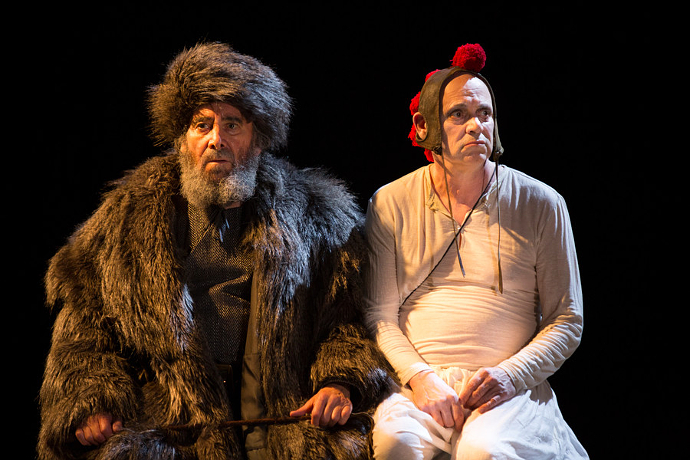
The descent into the grey-green dimension of madness (not only the senile kind, and not only the king`s) begins at once: a divestiture of the sovereign that proceeds from the circular golden symbols of royalty, through the skin-fur, until nothing remains but a plain nightgown. Sir Antony Sher carries it with superb alertness — his unambiguous voice sets every `note` of Shakespeare`s masterpiece vibrating with an intimate and scholarly interpretation, and revealing previously unheard ones. The fat knight steps into this role at the very moment when many are attempting it (at the Old Vic, an equally acclaimed Glenda Jackson, for one). His peculiar personality converts the poor mad old man into a clumsy bear playing with the elements and bending them — while he admirably the Prospero that lives in Lear.
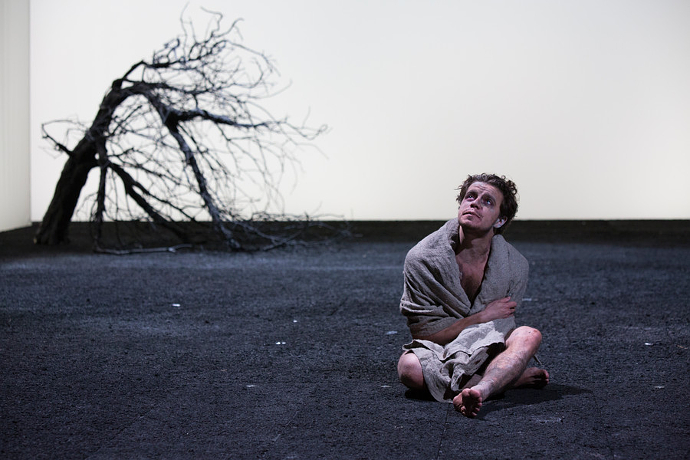
Music and light are of exceptional importance in this Royal Shakespeare Company production, presented first at home — at the Royal Shakespeare Theatre in Stratford-upon-Avon — and then in London, where it will run until 23 December. The sounds, Nature`s in particular, the king converses with as an equal, are reproduced on stage by a small orchestra. A presence steering the action, even when the stage machinery jams during a technical mishap — just as the storm is raging and a great golden shadow accompanies the poor old man`s delirious evocations. Besides him are the Fool (Graham Turner), ruddy and dressed as a chicken, and another liminal figure: the Calibanesque Poor Tom (Oliver Johnstone).
The deeper we enter the imaginary dimension, the more moments of spectacular dramaturgical tension accumulate — recalling the most choral and memorable Brookian stagings. A comparison that penalises here, given the need to adhere to the secondary plot, and the decision to assign the villain Edmund (Paapa Essiedu) a jester-like personality that feels somewhat out of register with the rest.
The nursing home anticipated by the opening cold, eventually reveals itself before the tragic epilogue. Nurses in black dresses and white aprons usher in that spectral modernity which is the true vantage point to observe the delirious narrative from. The transit toward reality is complete, and the smallness of the old infant arrives, in conclusion, at its definition: a trinket to be kept on a side table. Indeed, Victorian.
 Shakespearean Tales